
Posted on Leave a comment

Minecraft As A Mental Health Tool for INFJ and INFP Writers

Every four months or so, after consistent disciplined writing or editing, I’ll fall into what looks like a “two week Minecraft phrase.” Many writers enjoy gaming through writer’s block as a way to re-fill their creative wellsprings. And for women, especially for myself, the menstrual cycle brings its own challenges to the creative process. In fact, I’d go so far as to say that any woman writer shouldn’t write every day of the week anymore than she’d like to bleed every day of the week. Creative productivity expends creative energy. And there is as much truth to producing and resting and refilling around one’s biological reproductive cycle as much as there is to productivity around the four seasons of the solar year. 

Minecraft is my go-to game. Nostalgia. Familiarity. The sandbox aspect. My phase doesn’t come with the urge to start a new world. I have a forever world. But periodically, my creative tank goes dry and the options for refilling it include: outdoor activities, reading books in my genre, switching to another form of expression like painting or music. But sometimes I slip into that typical INFJ depression. There’s the Ni-Ti loop and its delightful rumination. My muses are silent, the novel’s world feels dark like all the lights went out and everyone parted ways. 

The Ni-Ti loop is where an INFX’s primary function Introverted intuition and tertiary function Introverted thinking  lead to paranoia, complexes, overthinking, social isolation, and detachment from reality.  Many INFJs know they need outside input, which can be had when you have a heart to heart with a friend or family member. But INFJs have had to be highly emotionally self-sufficient and are prone to self-isolation. If they’ve asked for help or for someone’s time, the slightest hesitation from the other party reinforces the INFJ’s tendency to believe that no one is coming to help them. And they’ll likely never ask that person again.

I often find myself in that same position. I don’t want to self isolate. I also don’t want to burden my friends with my needs. I do hope that someone will help me get out of the loop, but I find that I have to do it alone. During the spring, garden therapy helps. Getting hands in soil while the birds are singing on a sunny day is a great way to stop overthinking. But only so long as I’m gardening. The moment my tasks are done, the loop fires back up. So when my outdoor chores are done, my husband and parrot have been fed and nurtured, and I just don’t feel like reading, I’ll find myself opening Minecraft for the first time in months

Minecraft hits because it’s a game I can drop for long periods without losing my bearings. Opening that forever world is like returning home, escaping to a place that rejuvenates and refreshes. 

Then the spatial aspect. Navigating biomes, exploring caves, mineshafts, and structures is oddly relaxing. I go inside another 3D reality and do simple, almost mindless tasks.

This shuts down the Ni-Ti loop very quickly. Loneliness and emotional isolation fades away. The mind and body relax… even when a creeper explodes behind me. That elicits a laugh.
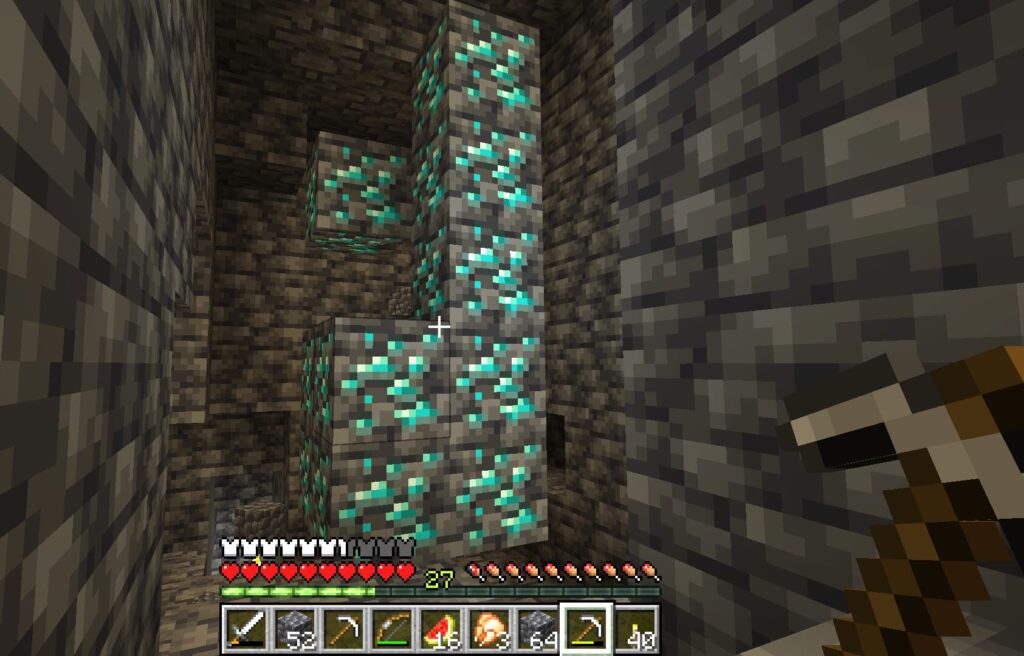
a screenshot of an unusually large, natural vein of diamond ore in Minecraft

I recently got the urge to pop into random servers for the thrill of it. I wanted to drop in on a couple of close friends, help them with whatever virtual project they were working on without any real investment, and then move on to the next server. I call this my “Wayfaring Stranger” urge. The “Wandering Good Samaritan.” One evening when I was particularly disappointed that no one in my “in the flesh” social circle had offered to do a one on one date with me, I took the plunge with a completely random vanilla survival server. It ended up being MCSB Vanilla.

There were two players and the admin present. They said “Hi” and I explored the town at spawn a while before falling into an RTP (random teleportal) and being swept thousands of blocks out into a jungle biome. In a few minutes of digging I stumbled across a mineshaft and as more players hopped on the chat got busier. Everyone was friendly and it felt safe and fun to be chilling with strangers, virtually. I wasn’t known, neither was I known deeply. I was more anonymous than with anyone in my real life. But I felt held. 

I never noticed my mind lull into the blissful rhythm of Minecraft engagement. I had no idea of how long I was going to stay or if I’d hop to another server in a few minutes. I was just existing for a moment, as if in a virtual cafe, unsure if I wanted to order from the menu and eat a while, or find another place to exist. But when bedtime came and I logged off, and I hit my pillow, I realized how quiet and calm my mind was. How I looked back at the day as full, vibrant, so much accomplished. 

And I was reminded that my perception of loneliness was a bit of a smokescreen. It was my reality. But it was not quite a true reality.  And something about the solitude of a Minecraft world, the depopulated potential, and the camaraderie of having other players in the chat is a bit of therapy in its own way. 

After about six hours of this, split across two separate evenings, I began to mentally return to my characters and my WIP. I felt inspired to compose a scene for a wildlife oil painting. And as the real sun’s light filtered through my office window, I told the server chat that I was hopping off for now, gave my well wishes to the other players, and picked up my sketchbook. 

The sandbox will wait. There’s no obligation to return until I’m ready. Minecraft’s development team might launch a fun new update, but the game’s mechanics will be the same. Tranquil and holistic. Endless spatial 3D. With blocks and textures so simple, the brain can’t possibly overthink. 

Is Minecraft a helpful motivational or anti-writer’s block tool for you too? What does your playing style look like and how long does it take your creative energy to return? 

About Laurisa Brandt

Independent Press and NYC Big Book Award Winning Author Laurisa Brandt writes immersive, character-focused speculative fiction balanced with rich world building and romantic subplot. While her novels embrace darker themes she aspires to offer readers hope and a bit of humor. Read More >>

Posted on Leave a comment

Open Criticism Is for Moral Issues Not Book Reviews

Tagging an author in a negative review is no longer a debate. The majority of us know it is poor form, but those who continue to do this are missing something. Tagging an author in a negative review is a form of open criticism. Open criticism is everywhere these days. 

It used to be that people used the printed newspapers to lambaste thought opponents and those caught in immoral behavior. But in the age of independent news, where literally anyone can platform themselves and accumulate a following, open criticism has become a seeming part of internet culture. 

There is nothing inherently wrong with open criticism. It may be necessary at times, and I believe it should be reserved for when someone has been conducted themselves unethically and needs to be held accountable. This often serves to bring the unethical behavior to light. It is the duty of friends to correct in private and praise in public, but not opponents. And certainly not when the behavior is harming others, for example: if a judge or politician was abusing his wife or children behind closed doors. 

Photo by Kyle Cleveland on Unsplash

Whenever open criticism is made, the person, organization, or party being criticized is invited to respond publicly. On a web platform, this invitation usually comes by way of a tag. This loops that party into the conversation, much like including a stamped, return addressed envelope in a snail mailed letter of criticism. 

Tagging an author in a positive review invites them in to warm and glowing public praise. 

Tagging an author in a negative review asks for a response to open criticism of their work. However, the author is in a tight spot, because it is socially unacceptable for the author to respond publicly to criticism of their work. Because there is no need for them to respond, there is no need for them to be included or notified of the open criticism. 

Tagging an author in a negative review is like inviting to your house someone who baked a cake that you didn’t enjoy eating, but also inviting all of your neighbors and friends to that same event. At the event, you’ll all be discussing how this person’s cake just wasn’t great and why you didn’t have fun eating it. It is socially unacceptable for the baker to speak up or attend, but everyone knows that they received your invitation.  

I think now you can see how tagging an author in a positive review of their work invites them to celebrate with you. It is acceptable because you are expressing gratitude and thanks for what they worked hard to put out in the world. I truly wish that open criticism was less commonplace in the world. But negativity garners more attention on the internet than positivity. 

It has never been about your right to having a negative opinion. The consensus on tagging an author in a negative review is based upon the rules of open criticism and the unspoken constraint upon authors that does not allow them to respond. 

A positive review is a compliment. A negative review is valid, but so is your thought that Sally’s bangs are childish and Robby’s laugh is obnoxious. You can tell Ruby that her flower beds look amazing and you’re so proud of all the hard work she put into them, and you can say it in front of anyone. But voicing a negative opinion to someone’s face, or criticizing their work to the company or department and cc’ing them in the group email has always been poor form. 

If you’re like, “Hold up. Books are products and the customer has a right to share their negative experience with a product or seller,” YES. As a customer, you absolutely have the right to publish your negative review with a piece of entertainment or a product. And you may do so on the bookseller’s platform where the author or content creator MAY see that review. But it is highly insensitive to prompt the content creator to respond to your negative experience by cc’ing them. 

It’s not very different from writing an author a personal letter letting them know what you disliked about their work. And where fan-mail comes from people wanting to tell an author how much they loved their book, the kind of mail coming from people telling an author how much they did not enjoy the book has only one term, currently. Hate-mail. 

Hate mail is the antonym for fan-mail. Hate mail consists of messages sent from critics, antagonists, or anyone opposed to the work or creator of the work. Unsolicited “constructive-criticism” falls under the hate mail umbrella.  

So remember, the next time you’re tagging an author in a negative review, you’re sending a new form of hate-mail, but publicly. Which is arguably worse than sending a private letter. Save your open criticism for moral issues.

Remember, just because someone admirable from the past, such as C S Lewis, offered public criticism of his peer’s work, that doesn’t mean it’s something we must consider admirable or even permissible today. We must not use one great person’s fault as license to practice it in our own lives, or else I must ask you, “If C S Lewis jumped off a cliff, would you do it too?” 

We should critique literature. And we should critique it thoroughly and in a way that invites discussion. And if we want to debate a peer, we may invite them privately to an open debate, to answer hard and constructively critical questions. 

But let’s save our open criticism for authors caught exploiting minors, for publishing houses doing unethical things toward their authors, and remember that a book review is rarely ever serious enough to warrant sending hate-mail over. Publish your negative opinions as you please. And leave the author uninvited to your community book-roast.

About Laurisa Brandt

Independent Press and NYC Big Book Award Winning Author Laurisa Brandt writes immersive, character-focused speculative fiction balanced with rich world building and romantic subplot. While her novels embrace darker themes she aspires to offer readers hope and a bit of humor. Read More >>