Posted on Leave a comment

Minecraft As A Mental Health Tool for INFJ and INFP Writers

Every four months or so, after consistent disciplined writing or editing, I’ll fall into what looks like a “two week Minecraft phrase.” Many writers enjoy gaming through writer’s block as a way to re-fill their creative wellsprings. And for women, especially for myself, the menstrual cycle brings its own challenges to the creative process. In fact, I’d go so far as to say that any woman writer shouldn’t write every day of the week anymore than she’d like to bleed every day of the week. Creative productivity expends creative energy. And there is as much truth to producing and resting and refilling around one’s biological reproductive cycle as much as there is to productivity around the four seasons of the solar year. 

Minecraft is my go-to game. Nostalgia. Familiarity. The sandbox aspect. My phase doesn’t come with the urge to start a new world. I have a forever world. But periodically, my creative tank goes dry and the options for refilling it include: outdoor activities, reading books in my genre, switching to another form of expression like painting or music. But sometimes I slip into that typical INFJ depression. There’s the Ni-Ti loop and its delightful rumination. My muses are silent, the novel’s world feels dark like all the lights went out and everyone parted ways. 

The Ni-Ti loop is where an INFX’s primary function Introverted intuition and tertiary function Introverted thinking  lead to paranoia, complexes, overthinking, social isolation, and detachment from reality.  Many INFJs know they need outside input, which can be had when you have a heart to heart with a friend or family member. But INFJs have had to be highly emotionally self-sufficient and are prone to self-isolation. If they’ve asked for help or for someone’s time, the slightest hesitation from the other party reinforces the INFJ’s tendency to believe that no one is coming to help them. And they’ll likely never ask that person again.

I often find myself in that same position. I don’t want to self isolate. I also don’t want to burden my friends with my needs. I do hope that someone will help me get out of the loop, but I find that I have to do it alone. During the spring, garden therapy helps. Getting hands in soil while the birds are singing on a sunny day is a great way to stop overthinking. But only so long as I’m gardening. The moment my tasks are done, the loop fires back up. So when my outdoor chores are done, my husband and parrot have been fed and nurtured, and I just don’t feel like reading, I’ll find myself opening Minecraft for the first time in months

Minecraft hits because it’s a game I can drop for long periods without losing my bearings. Opening that forever world is like returning home, escaping to a place that rejuvenates and refreshes. 

Then the spatial aspect. Navigating biomes, exploring caves, mineshafts, and structures is oddly relaxing. I go inside another 3D reality and do simple, almost mindless tasks.

This shuts down the Ni-Ti loop very quickly. Loneliness and emotional isolation fades away. The mind and body relax… even when a creeper explodes behind me. That elicits a laugh.
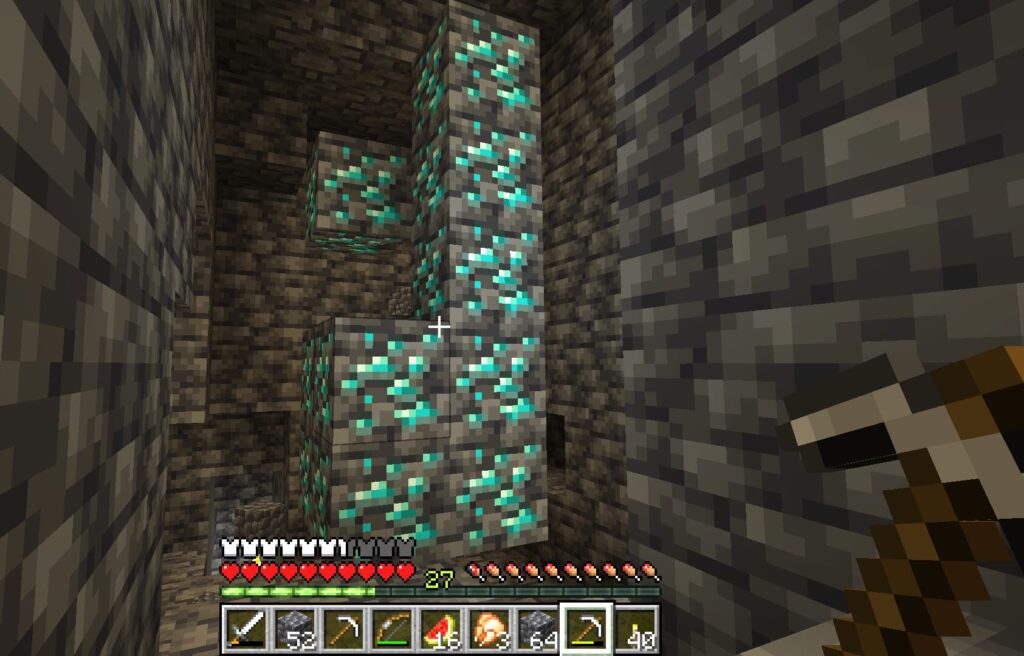
a screenshot of an unusually large, natural vein of diamond ore in Minecraft

I recently got the urge to pop into random servers for the thrill of it. I wanted to drop in on a couple of close friends, help them with whatever virtual project they were working on without any real investment, and then move on to the next server. I call this my “Wayfaring Stranger” urge. The “Wandering Good Samaritan.” One evening when I was particularly disappointed that no one in my “in the flesh” social circle had offered to do a one on one date with me, I took the plunge with a completely random vanilla survival server. It ended up being MCSB Vanilla.

There were two players and the admin present. They said “Hi” and I explored the town at spawn a while before falling into an RTP (random teleportal) and being swept thousands of blocks out into a jungle biome. In a few minutes of digging I stumbled across a mineshaft and as more players hopped on the chat got busier. Everyone was friendly and it felt safe and fun to be chilling with strangers, virtually. I wasn’t known, neither was I known deeply. I was more anonymous than with anyone in my real life. But I felt held. 

I never noticed my mind lull into the blissful rhythm of Minecraft engagement. I had no idea of how long I was going to stay or if I’d hop to another server in a few minutes. I was just existing for a moment, as if in a virtual cafe, unsure if I wanted to order from the menu and eat a while, or find another place to exist. But when bedtime came and I logged off, and I hit my pillow, I realized how quiet and calm my mind was. How I looked back at the day as full, vibrant, so much accomplished. 

And I was reminded that my perception of loneliness was a bit of a smokescreen. It was my reality. But it was not quite a true reality.  And something about the solitude of a Minecraft world, the depopulated potential, and the camaraderie of having other players in the chat is a bit of therapy in its own way. 

After about six hours of this, split across two separate evenings, I began to mentally return to my characters and my WIP. I felt inspired to compose a scene for a wildlife oil painting. And as the real sun’s light filtered through my office window, I told the server chat that I was hopping off for now, gave my well wishes to the other players, and picked up my sketchbook. 

The sandbox will wait. There’s no obligation to return until I’m ready. Minecraft’s development team might launch a fun new update, but the game’s mechanics will be the same. Tranquil and holistic. Endless spatial 3D. With blocks and textures so simple, the brain can’t possibly overthink. 

Is Minecraft a helpful motivational or anti-writer’s block tool for you too? What does your playing style look like and how long does it take your creative energy to return? 

About Laurisa Brandt

Independent Press and NYC Big Book Award Winning Author Laurisa Brandt writes immersive, character-focused speculative fiction balanced with rich world building and romantic subplot. While her novels embrace darker themes she aspires to offer readers hope and a bit of humor. Read More >>
Posted on Leave a comment

The Day I Fell In Love With a Typewriter

Estate auctions are a big deal in Pennsylvania. Whether the owners are deceased or downsizing for retirement or assisted living communities, there’s an estate auction happening three days out of every week in our area. To my Alabama blood, it seems to be a preference of Amish and Mennonite culture. But maybe they’re popular in other areas of the US as well. 

My husband and I popped into one such auction twenty five minutes north of where we live on the hunt for unique art pieces for my office. My frustrations with encountering AI generated images has compelled me to look for second-hand pieces.

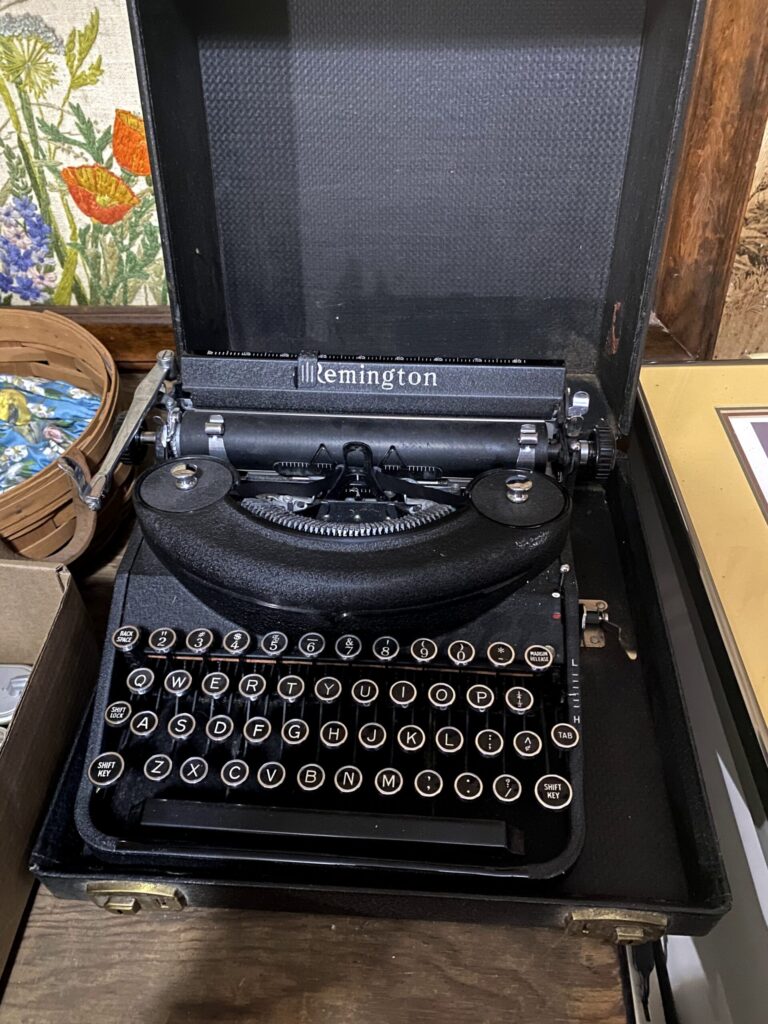
As we perused a garage of tables loaded with dusty artifacts of past decades, my eye fell upon an open case containing a strange device. A dinosaur machine. Something I’ve barely seen in film and can’t recall having ever seen in person.

For a moment, it felt as though I was sucked through a portal into the 1930s

I stared at the typewriter. It existed like an omniscient time traveler, confident, graceful, and austere. Someone who never once questioned his value in a world madly dashing after the next shiny, new advancement. And that mystery compelled me to touch one of its keys. 

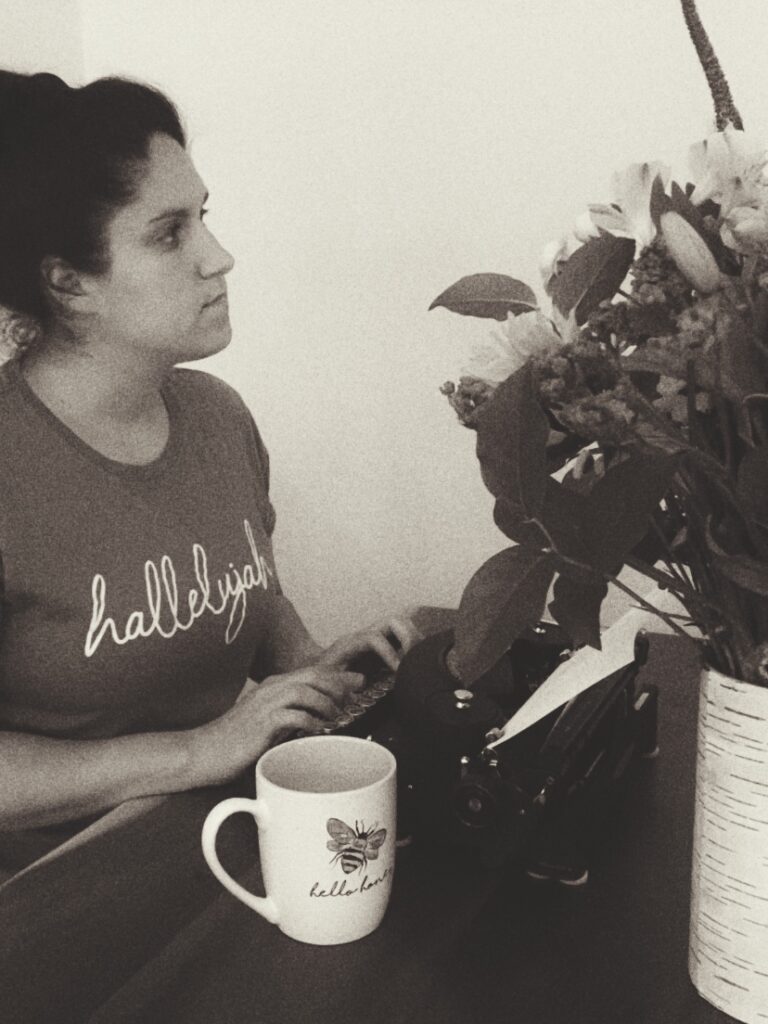
Ding! The carriage bell stirred something in my heart beyond my fantasies of how nice it would be to have a typewriter for decoration in my office. How all the cool writers had amber vignette photographs of themselves writing their novels on a typewriter instead of a computer. Though it would be nice to use it for writing update photos. 

Would it become a forty-pound dust collector on my bookcase? Would I have to fight other bidders for it only to regret how much I paid for it? Did it even work well enough that I might be able to peck out a few words for fun? Type out a letter to a friend for the novelty of it? 

I pulled up my phone and began searching for more information on the model before me. At a glance, I learned that models similar to this one were selling online for around $500.00 USD. If this machine worked, I had an amazing find. 

Since the sellers of the estate were living and present, I was able to ask the owner if the machine still worked. 

She reached toward it with a wrinkled hand. “It was given to me as a gift a very long time ago. I don’t think it was used very much.” 

When that was all she would say, I thanked her, realizing that she did not even know its potential value and therefore the auctioneer wouldn’t either. As the auction for the housewares was just beginning, I ran to the auction office trailer and claimed my bidder’s ticket. And then, I waited, as lot after lot of seasonal décor, collectible plushies, glassware, plate ware and more sold for cents and dollars. 

I stood for three hours, waiting for the sales assistants to bring the typewriter out of a back room and up for auction. I watched as another typewriter I had somehow missed in my perusal of the stuff, an electric Sears machine, sold uncontested for just a few dollars. But my doubts grew. Was it worth it? Was it a vanity purchase? Just so I could show my social media followers that I had a typewriter? And then what? Was I wasting my day standing here to get a heavy, old dust collecting machine? Was it junk? Or if a treasure, would all my waiting be in vain if someone else here knew its value and was willing to pay a high price? Would it go for $75? $150? 

As noon came and went, the steady drizzle, stagnant air, high humidity, my achy legs, overstimulation from the auction, headache, hunger, and thirst demotivated me further. What if I had buyer’s remorse? 

When the typewriter came up for auction, the auctioneer gave it a cursory look and started the bidding at $50. Then he dropped to $35. Then $15. And after a long, bored silence from the crowd, he asked for $5. Since I was sweating profusely from my armpits and feeling dizzy, I’d put my husband, more experienced at bidding, up to the task. He raised his hand. After a half minute of trying to conjure a second bidder into the arena, the auctioneer shouted, “SOLD! For Five dollars.” 

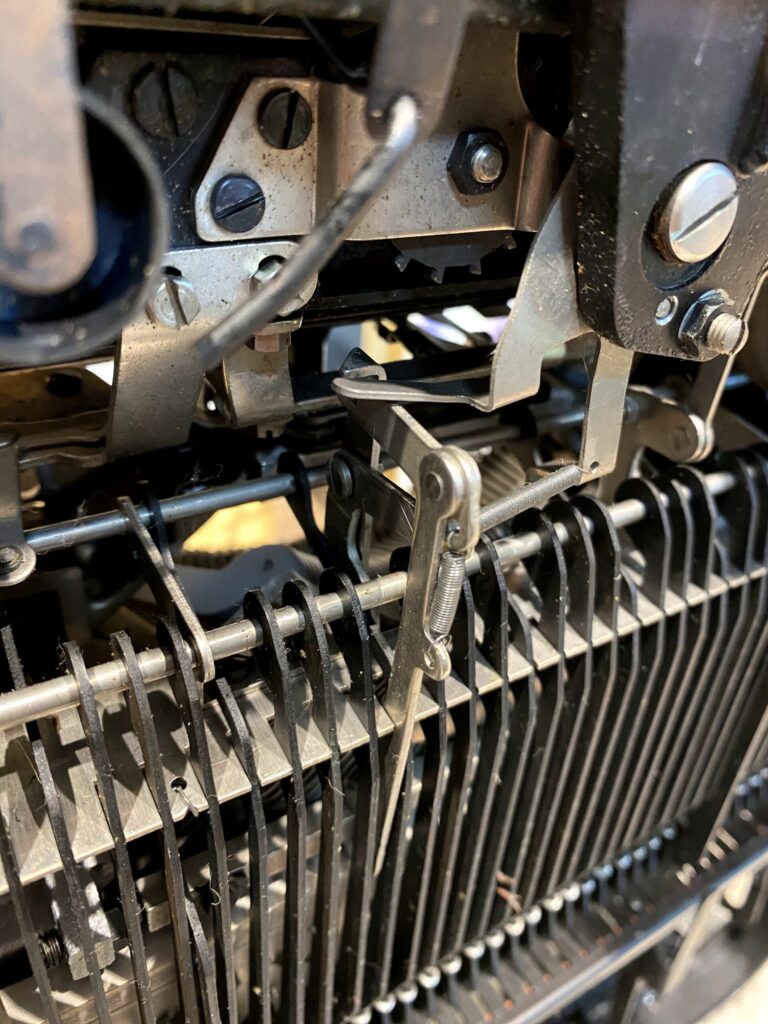
I danced a little jig right there on the spot and wriggled with delight as the heavy black case was passed to me. When I got home I took the machine out of its case and began to fiddle with it. I immediately found that the tape carriage mechanism didn’t rise high enough to meet the keys. The space bar also did nothing.

Tinkering with it and turning it over a while, I tracked the chain of intricate parts that made the thing tick. Two of those mechanisms were disengaged. After a little pushing, prodding, and tugging with a pair of tweezers, I managed to get everything reconnected and fed a piece of paper through the carriage to test it out. 

Click. Clack. Click. Clack.

Faded letters appeared on the paper before me. A ribbon that was clearly more than four decades old was still imparting ink. 

I dutifully typed out a short message from the typewriter to myself. 

Hello… My name is Remington. I am a typewriter from the 1940s. 🙂

And at that moment, it was as if I'd fallen in love with someone from another century.

A social event called me away from getting to know Remington for the remainder of the evening. I passed the hours at said event missing my new acquaintance, thinking about his chime just before the carriage reached its end, the weight of his keys beneath my fingers, and the mechanical artistry of his interior. 

As soon as I returned home, I spent a little more time typing away on Remington, trying to grow more acquainted with this distinguished machine. 

I couldn’t believe I’d been tempted to walked away from the auction and call it a day. Now I couldn’t imagine walking away without this typewriter. What a fool I’d almost been! What a magnificent piece of engineering I’d inherited for just $5.00 USD. 

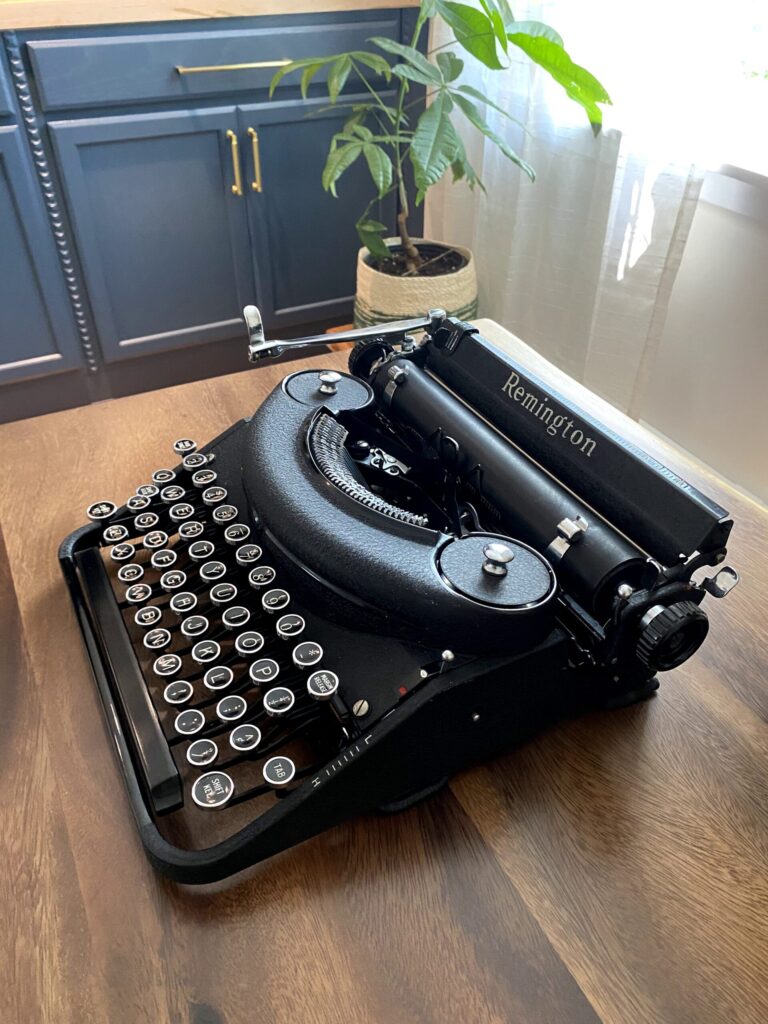
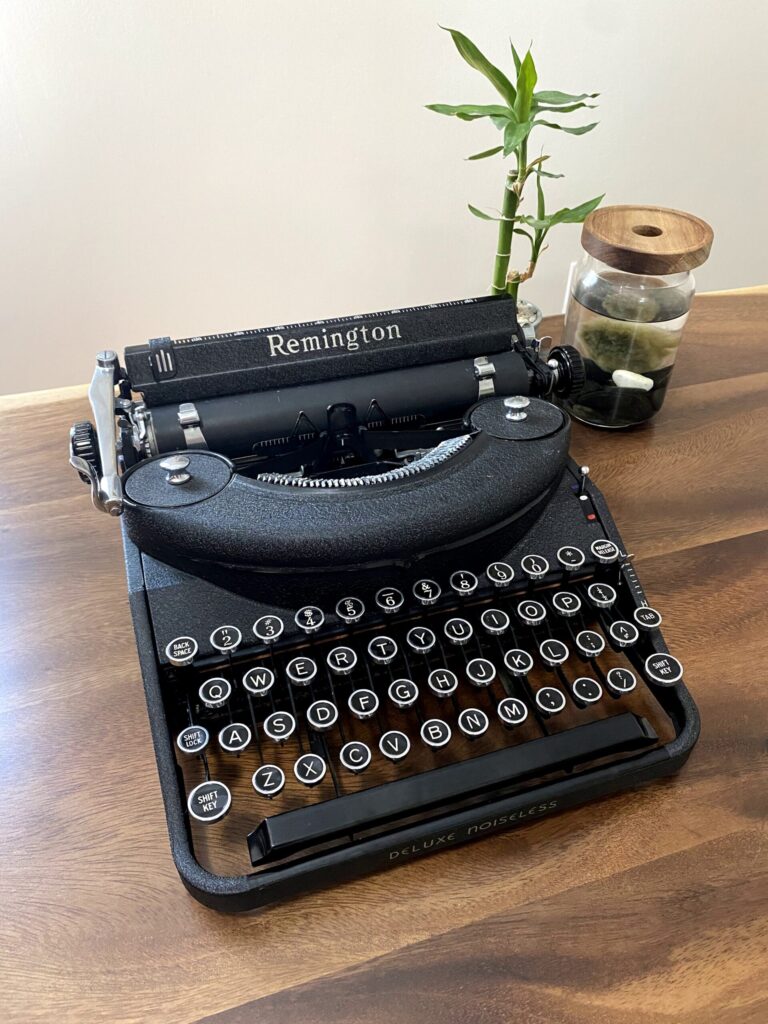
Finally locating the serial number on the back (ND166044), I compared it to the typewriter database and learned that it was manufactured between January and February of 1939. Production of the Remington Portable Noiseless Deluxe typewriter ended in December of 1940 as factories switched to wartime production, though at least seven more machines are believed to have been made between 1940 and 1942. 

I am proud to be the inheritor of this piece of history. The first official document I typed out was a letter to my dad for Father’s Day. In it, I recalled my grandfather’s use of a typewriter he kept hidden beneath a piece of furniture in their apartment in Timisoara, Romania for translating Christian materials during Nicolai Ceaucescu’s Communist regime. My grandfather was born January 7th, 1939. 

In 2039, my typewriter will be 100 years old. And unless someone pries it out of my cold, dead hands, I will forever be its keeper. And it will be functional, practical, graceful and austere, like an omniscient time traveler, unafraid of the shiny new gadgets and technologies.  

Why I love my “new” typewriter is no mystery at all. It beckons me into a slower-paced world, free of distraction, free of social, political, and environmental chaos. It reminds me that value and relevance are qualities that never fade away, but are only visible to those attuned to them. 

And if, one day, my estate is ever up for auction and I haven’t bothered to sell old Remington for what he’s truly worth, I hope some young writer in the crowd gets him for $5.00…uses his tireless keys, cherishes his carriage bell’s ring, and finds a bit of solace from our progressive chaos for another half-century.

Laurisa Brandt writes speculative fiction with a dash of romance. Her award winning Birthright of Scars duology has appeared in the Susquehanna Style magazine.

When not writing emotional, thought provoking, high-action stories with deep spiritual themes, Laurisa can usually be found baking scrumptious sourdough bread or enjoying the outdoors. 

She resides in south central Pennsylvania with her husband, her 1930’s Remington typewriter, and her adopted Timneh African Grey parrot, Hercules.